What Is Self Advocacy?
Self-advocacy is a way of voicing yourself. Self advocacy specifically pertains to the ways in which you choose to voice your understanding your own strengths and weaknesses, developing personal goals, being assertive (meaning standing up for yourself when you need to) and making decisions.
Below is a visual explanation as to what self advocacy is, and why it's an important skill to learn in life.
Below is a visual explanation as to what self advocacy is, and why it's an important skill to learn in life.
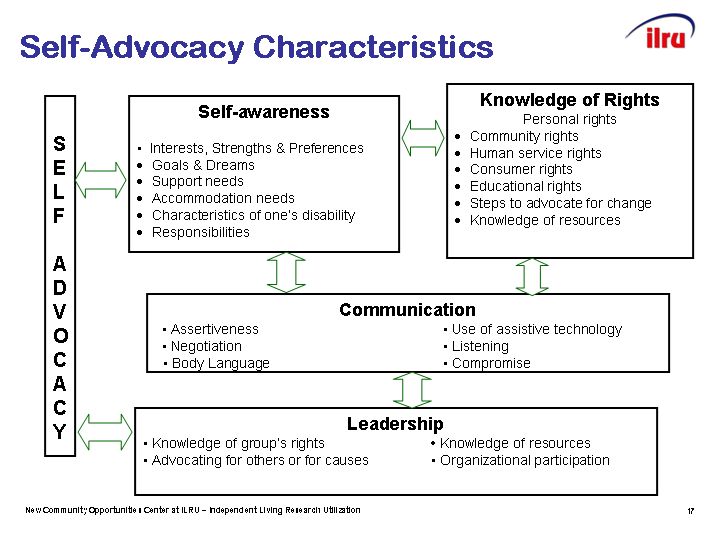
WHAT ARE SOME WAYS YOU CAN WORK ON SELF ADVOCACY SKILLS?
UNDERSTAND WHAT "EC" IS
Special education ("EC") is an important part of the educational experience. In any school system, the function of EC is to help identify
children with unusual needs and to aid in the effective fulfillment of those
needs. Both regular and special school programs play a role in meeting those educational needs of children with exceptionalities.
The primary goal of and EC teacher is to help build learning opportunities that assist the children with these exceptionalities (specific needs) in school environment. Your EC teacher is there to serve as a support system and to assist
your classroom teachers in managing your specific needs in the classroom setting.
Understand why EC is important to you and your learning needs
Understand why EC is important to you and your learning needs
It's important to be aware of what your strengths and needs are in the learning process, including helpful strategies that will assist you in succeeding, and utilizing the accommodations granted to you in order to assist you in your active learning process. To gather this information,
you can review testing results with your EC teacher or Classroom teachers to help reflect on your learning challenges, successes,
and preferences.
COMMUNICATE, COMMUNICATE, COMMUNICATE!
One of the easiest ways to develop self advocacy is by finding a teacher who you feel comfortable talking to, and who you feel comfortable expressing your needs or concerns. This is a great starting point for developing self-advocacy skills that will help you with a starting point, so that the goal will be for you to have the ability to talk to any and all of your teachers independently.
Be appropriate
One of the important things to remember when communicating, with anyone, is your delivery. No conversation ever goes right when you address it when you are upset, sad, mad etc. So it's important, to make sure you take a minute to acknowledge how you are feeling, but then also take a step back to identify why you are upset, and what you can do to fix it. Blowing up on someone, especially a teacher or adult is not appropriate.
PARTICIPATE ACTIVELY
You cannot just sit in a classroom and expect to absorb information. You need to actually be an active part of your learning, by asking questions, answering questions and completing assigned classwork. The work that is assigned to you by your teachers is not meant to overwhelm you, but it will if you are not taking on the responsibility of attempting the work on your own, and then asking questions when you do not understand something. One of the biggest mistakes a student can make it coming to ONE question on an assignment that they do not know, and then simply using that as an excuse not to complete the assignment. KEEP GOING! Jot a note down on the sheet in pencil, so that you will remember to ask the teacher the question later if it is something you have trouble with outside of class time.
You cannot just sit in a classroom and expect to absorb information. You need to actually be an active part of your learning, by asking questions, answering questions and completing assigned classwork. The work that is assigned to you by your teachers is not meant to overwhelm you, but it will if you are not taking on the responsibility of attempting the work on your own, and then asking questions when you do not understand something. One of the biggest mistakes a student can make it coming to ONE question on an assignment that they do not know, and then simply using that as an excuse not to complete the assignment. KEEP GOING! Jot a note down on the sheet in pencil, so that you will remember to ask the teacher the question later if it is something you have trouble with outside of class time.


0 comments:
Post a Comment